

There’s a dynamic in performance reviews that doesn’t get talked about much in construction, but it has a real impact on the careers of Project Engineers.
It’s called recency bias.
In simple terms, people tend to remember and judge based on what happened most recently, even if earlier performance was stronger or more representative. Decades of psychology and organizational behavior research back this up – studies on memory recall and on performance appraisals consistently show that recent experiences carry disproportionate weight.
For Project Engineers, that matters. A lot.
Because in construction, the “most recent” part of the project is usually closeout (and that’s often the most chaotic).
Human Psychology at Work
Think about the lifecycle of a project.
Most of the job may run steadily: Coordinating subs. Reviewing submittals. Solving problems. Keeping things moving. Managing documents. Handling the details that nobody notices when they’re going well.
…Then, you reach closeout.
Deadlines tighten. Requests pile up. Owners expect polish. Teams scramble to pull everything together.
And unfortunately, this is also the window when:
-
leadership is paying closer attention
-
emotions are highest
-
final payment gets witheld until closeout is complete
-
performance reviews are often being written
So even if the majority of the project was handled extremely well, a stressful closeout can become the dominant memory of the project – and of your performance.
That’s recency bias at work.
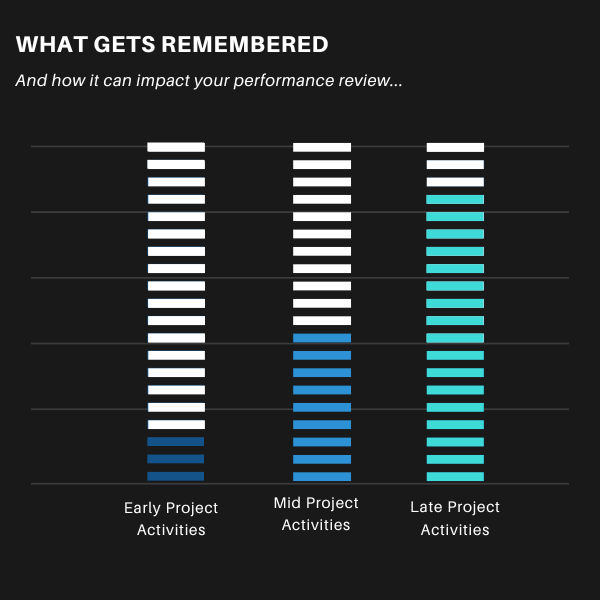
What this means for Project Engineers & Closeout Teams
Here’s the unfortunate reality: You can do excellent work for months. You can keep things organized. You can solve issues before they become problems. You can be the steady hand on the project.
But if closeout turns into:
-
chasing missing documentation
-
pulling submittals together at the last minute
-
scrambling to assemble client deliverables
-
responding to “where is this?” emails all day
…that period becomes the most memorable part of your performance.
And in a performance conversation, perception matters just as much as the facts. Recency bias can make a well-executed project look messy simply because the final stretch felt messy.
Same capability. Same effort.
Different ending. Different story.

Performance reviews can be more “vibes” than “data”
Performance reviews are intended to be objective, but they rarely are. People evaluate based on what they remember clearly. And what they remember clearly tends to be the high-stress, high-visibility moments.
In construction, that usually means the end. So:
- Smooth closeout increases confidence in you.
- Chaotic closeout raises questions (fair or not).
How to use this to your advantage (and secure moving up)
You don’t eliminate it. You plan for it.
The most effective move a PE can make is to start thinking about closeout earlier than most people do.
When closeout is proactive instead of reactive:
-
documentation doesn’t pile up
-
deliverables don’t require sprinting
-
communication stays cleaner
-
handover feels intentional, not frantic
“They were calm, organized, and in control from start to finish.”
That’s what builds trust. That’s what gets noticed. And that’s what helps drive stronger performance evaluations (and career growth).
Be proactive. Start working closeout early, before you have to be told to start working closeout (you’re already late that point).